
By To Your Health and Mark Hubbard
You’ve probably heard the advice a hundred times: “Eat less processed food.” But if you’ve ever stood in the grocery store aisle squinting at a nutrition label and thought, “What even is ‘disodium inosinate’?” — you’re not alone. The word “processed” gets thrown around a lot, but it actually covers a pretty wide spectrum. Understanding where your food falls on that spectrum might be one of the most useful things you can do for your health.
The Corn Test: A Simple Way to Understand It
Let’s use corn as an example, because it takes us on quite a journey.
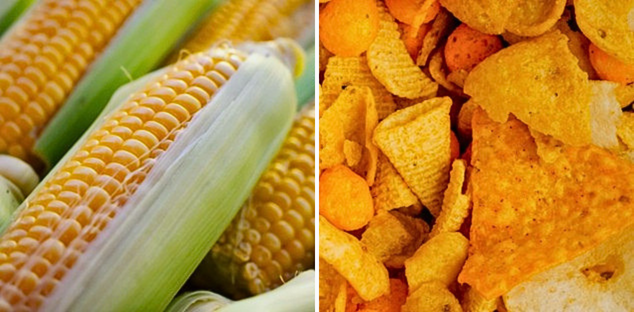
Pull an ear of corn straight from a backyard garden, and you’ve got an unprocessed food full of fiber, vitamins, and natural sweetness. No ingredient label needed. Now walk into the grocery store and toss a bag of frozen corn in your cart. Still pretty wholesome — it was just picked, blanched, and frozen. Step it up a bit, and you’ve got canned corn, which has been cooked and preserved with a little salt. Still recognizable. Still something your great-grandmother would call “corn.”
Then there are Doritos and Fritos. These are technically made from corn. But here’s the thing … you could never make them at home. Go ahead and try to track down “maltodextrin,” “disodium phosphate,” or “Red 40” at your local grocery store. You won’t find them. These ingredients aren’t in any kitchen pantry on earth. They’re chemically derived compounds designed in laboratories, added to enhance flavor, color, shelf life, and that irresistible crunch that makes you eat the whole bag. That’s ultra-processed food in a nutshell.

So What Makes a Food “Ultra-Processed”?
Food scientists use a system called the Nova Classification to rank foods by how much they’ve been industrially transformed. Ultra-processed foods at the fourth and highest tier are industrial formulations that typically contain five or more ingredients, including substances you’d never find in a home kitchen: high-fructose corn syrup, hydrogenated oils, artificial flavor enhancers, emulsifiers, and artificial colors and flavors. The key giveaway? You couldn’t recreate these foods from scratch even if you tried.
In the U.S., this is no small issue. An estimated 70% of packaged products in the American food supply fall into the ultra-processed category, and children get over 60% of their daily calories from these foods.[5]
What the Science Says
The research here is hard to ignore. A major umbrella review published in The BMJ — covering nearly 10 million participants across 45 studies found that greater exposure to ultra-processed foods was consistently linked to higher risks of heart disease, all-cause mortality, mental health disorders, and more. A separate 2025 series in The Lancet found that diets high in ultra-processed foods were associated with 12 chronic health conditions, including obesity, type 2 diabetes, cardiovascular disease, depression, and premature death.
More recently, a 2025 study presented at the American College of Cardiology found that each additional 100 grams of ultra-processed food consumed per day was linked to a 14.5% higher risk of hypertension and a 5.9% increased risk of cardiovascular events.

Small Shifts, Big Wins
You don’t have to overhaul your entire diet overnight. Start by playing the “corn test” with your own grocery cart. Can you picture this food growing in a field or being made in a real kitchen? If yes, great. If the ingredient list reads like a chemistry exam, it might be worth reaching for something a little closer to its roots … literally.
Swap chips for popcorn you pop yourself. Trade the flavored instant oatmeal for plain rolled oats with fresh fruit. Choose frozen corn over the canned version when sodium is a concern. These are small swaps, but over time, they add up to something meaningful.
Your body knows the difference between corn on the cob and a Dorito, even if the label tries to convince you otherwise.
Next Week: Tips for Reducing Ultra-Processed Foods from Your Diet
Linda Hubbard is an RN, Nutrition Specialist & Founderof To Your Health, a national nutrition and wellness coaching firm based in Wallingford, CT.
Mark Hubbard, is a writer and editor with years of experience in the health and science sectors. He specializes in distilling complex topics into understandable, engaging text.